If you’re planning an extended Indian motorcycle tour, a backpack alone isn’t likely to carry all your essentials.
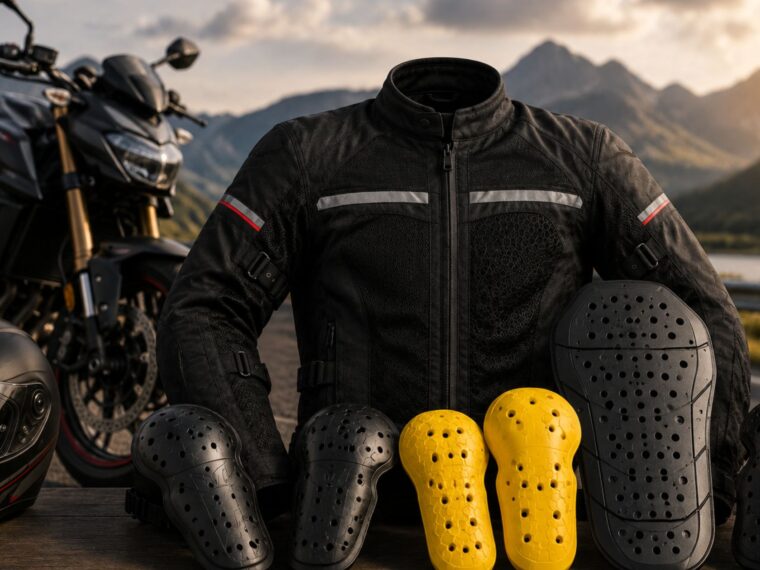
While carrying all the biking gear such as a riding jacket, rain protection, tools, spare clothing, essential documents, gadgets and equipment for camping etc. The need for proper luggage mounting on the bike naturally arises.
This is where a motorcycle luggage carrier plays a crucial role, providing an anchor point for your luggage bags, top box and other touring accessories. Selecting the right bike luggage carrier however is more than just picking the largest or least expensive model; motorcycle type, its mounting options, load-bearing capability, kind of luggage you intend to carry and the terrain you plan to cover all play a part.
For city commutes, even a minimal bike luggage rack might suffice. On the contrary, a sturdier motorcycle touring bike luggage carrier supported with saddle bags or even a waterproof bag for the back would offer considerably enhanced carrying capacity.
In this article, we’ll highlight the most frequent types of motorcycle carriers, help you find a suitable model for your bike, address mounting and integration issues, cover available accessories, and cover aspects that would benefit you before a purchase in India during 2026.
What Is A Bike Luggage Carrier & Do You Need One?

Bike luggage carriers are mounting solutions adapted for motorcycles or bicycles that help haul the necessary gear and equipment in a more secure and convenient manner. On motorbikes, they’re often attached to the rear to accommodate luggage racks or touring apparatus such as top box etc.
You may find a bike luggage carrier rack indispensable IF:
- You embark on frequent and lengthy motorcycle journeys.
- Your backpack feels uncomfortable or becomes overly burdened, limiting its transport capacity.
- You pack heavy touring or camping equipment.
- You plan to install a top box on your motorcycle.
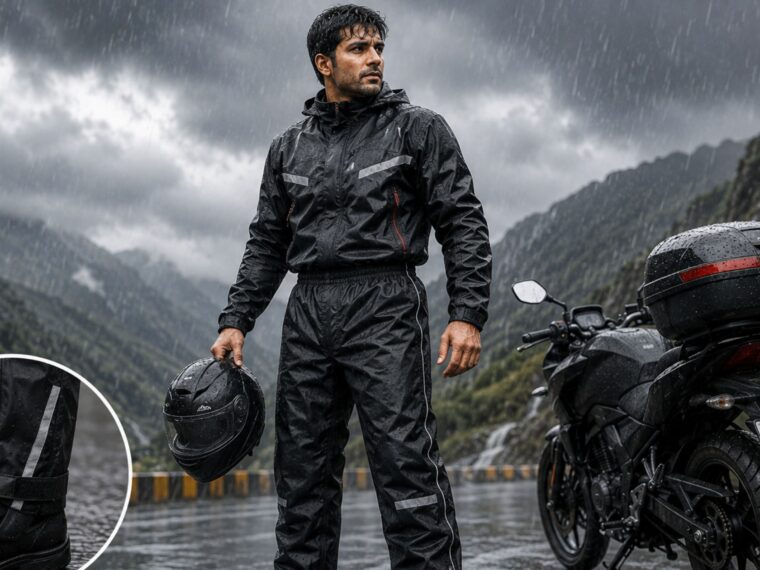
- You wish to pack sufficient rain gear along with ample clothing for all kinds of climates.
- You’d prefer not to restrict your torso mobility and rather distribute the luggage among your motorbike.
Furthermore, carrying luggage on the bike on a sturdy mount will help you fasten things securely and prevent any shifting of luggage on your back. Yet, having a bike luggage carrier per se doesn’t assure safe luggage carrying and one still needs to consider proper load and position for even weight distribution.
Types Of Motorcycle Luggage Carrier
Depending on the style and intended use, the below are the many types of motorcycle carriers:
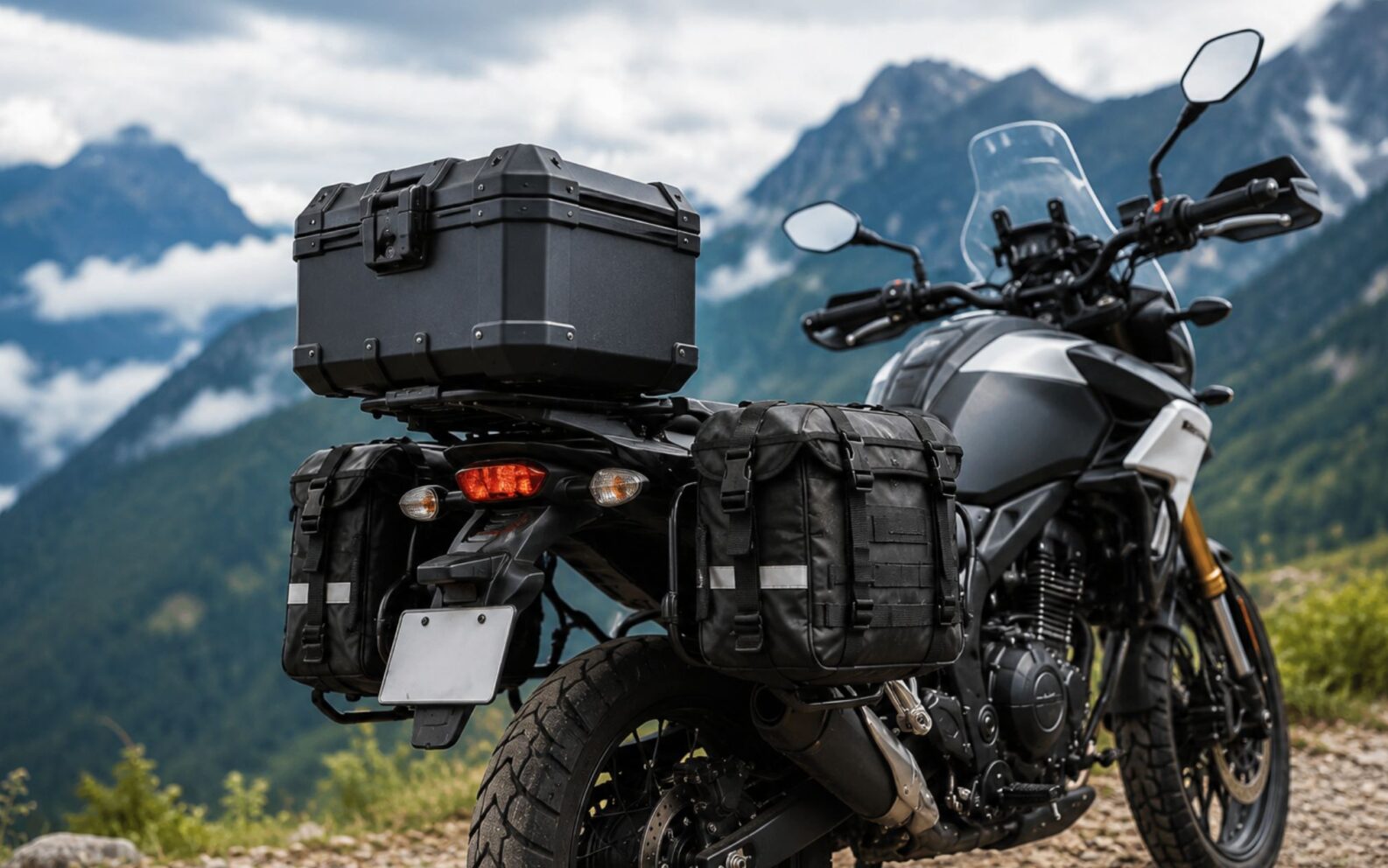
Bike Luggage carrier Rack / Rear Rack – A universally-acclaimed solution for mounting luggage behind rider and passenger. You could attach soft luggage, cargo strapped on, bungee straps, or a dedicated top box. Generally the go-to choice among riders for long tours.
Saddle Bag Stay – Designed to keep saddle bags, also known as panniers, separate from the bike’s wheels, suspension and exhaust. Essential when you carry panniers on your motorcycle.
Handlebar Luggage Mount – Often small to mid-sized bags that can be clipped onto your handlebar. Best suited for smaller essentials like a phone holder, a mini storage bag, or your GPS navigation system. This doesn’t offer additional carrying space for big stuff.
Top Box Carrier Rack – a rack built specifically to secure a top box, either a basic one or a much advanced touring box which acts as a complete luggage box with its built-in lock system. It’s good for riders who desire an extremely secure and protected touring experience along with easy access to their travelling gear.
Ultimately, a selection has to be made considering what you want to carry rather than how large a space you’re aiming to accommodate.
Motorcycle Luggage Carrier – Selecting the Appropriate Load Capacity
An essential aspect for your motorcycle luggage rack choice – the weight it can bear. Simply because a bike luggage carrier looks robust and big doesn’t mean it can take up additional weight. It largely depends upon the structure, installation mount and of course, the rear/front sub-frame of the motorcycle. Before you begin placing weight on it, ensure you check out all about the vehicle mount and load capacity:
- Load capacity as quoted by the manufacturer
- Number and position of mounting points of the rack
- What material is the rack made up of. You don’t want your rack made out of plastic.
- Compatible for the specific motorcycle that you have?
- Type of luggage to be mounted – some heavier if you are travelling a great deal?
- Center aligned
- Any interference in leg and body space for rider as well as passenger
Even if a particular rack looks strong and the frame is rigid doesn’t guarantee you should fill it up to its brim, or anything beyond what the bike manufacturer has recommended as maximum for luggage carrying by default. Remember to also check the motorcycle’s total recommended luggage load if one is available from the company. Distribute load with caution when travelling longer distances and place heavier items at the bottom and secure luggage well to prevent toppling over and wobbling, this will also give you stability during the entire drive.
Saddle Bag vs. Motorcycle Luggage Carrier: Who Does Better Touring?
Saddle bags and rear motorcycle luggage carriers answer somewhat different needs of long-distance riders. A rear bike rack provides a single, elevated platform for your top case or another large bag.
Saddlebags attach to the sides of the motorcycle-often secured by an under-seat strap, saddle bag stay, or support system. These distribute the motorcycle’s weight across its structure and may have a greater overall carrying capacity.
Rear rack advantages:

– Luggage stays readily available for access.
– Necessary when carrying top boxes
– Offers room for a huge duffel bag or other large items mounted on the rear.
– Easy to mount.
– Suitable for everyday commuters too.
Saddle bag advantages:
– Loads luggage across sides of the motorcycle
– Good option for carrying more amount of storage for long tours
– Luggage could be somewhat at lower heights on the motorcycle for balance
– Helps in carrying a lot for long riding escapades.
For a brief weekend vacation, a saddlebag and top box combined with possibly a single bag on top would give you best performance along with ample luggage capacity. However, if you need to pack light and can use your torso as your baggage storage, you could simply opt for a solo rear rack with one waterproof bag strapped at the rear.
Top Box Rack Vs. Rear Carrier – Know the Difference
Often the term “top box rack” and “rear carrier” become interchangeable, this is not always correct.
A “rear carrier” is quite a broad term for the rack system which will usually just give a base onto which various forms of bags, or accessories can be mounted.
A “top box rack” is usually made specifically to take a certain type of top box mounting system.
A top box may be preferred for riders who prefer a rigid, enclosed luggage compartment that can shield against some weather conditions, for those who want a place to secure smaller, often used items.
Whereas a soft bike luggage carrier will often have more flexibility and a lighter construction.

Ultimately the choice comes down to personal preference for these categories:
- Rigidity
- Lightness
- Weather proof ness
- Accessibility
- Larger carry capacity
- Ease of removal
Universal Vs. Bike Specific Carrying Devices – Compatibility Explained
One of the greatest mistakes a potential buyer can make when shopping for a bike luggage carrier is simply believing that a “universal” fit is possible across all bikes.
Although the vast majority of universal bike luggage carriers have adjustable mounting solutions available, the frame and mounting points on a bike will all differ in many aspects, resulting in a non-perfect fit when they are applied.
A bike luggage carrier has been designed for a specific make and model of a bike and thus provides the greatest fit.
When determining the right bike luggage carrier device you need to take into account:
- The make and model of the bike
- The model year of the bike
- Existing luggage rails/mounting bars on the bike
- The exact locations of bolt-holes
- The design of the tail of the bike and seat fitting
- The position and proximity of exhaust and indicator lamps
- The amount of rear seat space available
The rack needs to be able to fit securely on your motorcycle without conflicting with essential parts of the bike’s frame and operation.
Before purchasing a bike luggage carrier consider what other bikes there are, and choose the one that seems to match the listing more than believing that the term universal automatically implies “any bike”.
Fitting a Luggage Carrier on Royal Enfield, Yamaha, Honda, & KTM
Fitting the luggage device depends entirely on the motorcycle. There isn’t one method for all bikes.
On a Royal Enfield, Yamaha, Honda or KTM the procedure is to find the recommended mounting locations set out by the manufacturer, or the bike luggage carrier designer.
Step 1. Finding the right mounting points: Position the bike luggage carrier over your motorcycle and note exactly where all of the appropriate holes should align with the bike.
Step 2. Removing required components: depending on the bike this might mean temporarily removing your existing grab handle, bolts holding down the tail plastic etc.
Step 3. Positioning the rack: Ensure the bike luggage carrier is placed correctly to allow room between it and the exhaust, indicators and seat.
Step 4. Fitting the rack: Secure the rack in place, first with the bolts provided, then tightening them up as per the mounting instructions provided with the bike luggage carrier.
Step 5: Testing it out: Move the bike around to ensure there is enough clearance and that there is no rattling or movement from the bike luggage carrier, although without load it can be difficult.
Step 6: A dummy run: Before setting off on a long trip it is recommended that you load the carrier with a small amount of luggage for a short ride around your area to see if there is enough support underneath the bike luggage carrier.
If it involves any modified drilling to the frame or any uncertain fittings that could damage the motorcycle’s frame, it is always advisable to let a professional carry out the task.
bike luggage carries Carrying Devices Accessories: Bags, Bungy Nets & Waterproof covers
A basic carrying device will, though functional, be far less use without additional accessories:
-
Motorcycle Luggage Bags
Soft luggage bags, that are flexible and easy to remove, are great for clothing, travelling accessories etc.
-
Bungee Nets bungee nets are quite a good way of strapping on non essential luggage to a rear carrier, but are really a poor choice for anything that you would rely on to carry your main load of equipment.
-
Waterproof covers-Rain will often come out of nowhere and can ruin the contents of your luggage, a waterproof cover will protect it against rain.
-
Bungee Cords– Bungee cords will carry any bag size if they are positioned correctly; ensure that your bungee cord is in good condition and that your hooks are not likely to slide free and contact either wheel.
It’s not just the bike luggage carrier itself which counts; when combining this with a good quality luggage carrier bag and the correct attachment systems, a bike luggage carrier is of much better service.
TrekNRide bike Luggage Carriers & Mounting Accessories-The Full range
TrekNRide has manufactured various forms of luggage-carrying devices for use while both commuting to work, and travelling across country.
There are various bike luggage carrier available, alongside saddle bag supports, luggage bags, bungee accessories, and a wide array of other travelling equipment.
A bike luggage carrier is one piece in a greater setup and to derive the full benefit from it a luggage-carrying device should be paired correctly with others. For example, while a bike luggage carrier is being used to carry equipment you will need luggage bags alongside it that are designed to fit onto a bike luggage carrier carrier; and a saddle bag stay will hold them away from the bike itself.
The choice of any accessory will also depend on the make and model of the bike, how much the rider would want to carry, and the distance they are travelling.
So for use as an everyday bike luggage carrier a smaller rack will suffice, but for travel with a great distance to cover it would make sense to pack smart, and use the correct carrier/luggage bag and attachment combination to be able to travel in comfort.
Frequently Asked Questions on Motorcycle Carrying Devices
What is the load capacity of a bike luggage carrier?
This totally depends upon the carrier in question, and the mounting system that is holding it upon the bike. Always check the manufacturer’s specifications before mounting anything heavy on.
Are bike luggage carrier necessary when travelling on a motorcycle trip?
It is of course not essential but makes travelling and carrying a load of equipment on a bike much more manageable and secure than without.
Will a Universal carrier fit on my bike?
“Universal” has the tendency to be a meaningless word at times; there are universal carriers that will fit virtually any motorcycle but the fit may not be as snug as if it were bike specific. Consider what type of motorbike you have when deciding what to go for.
Is a Rear Carrier or Saddle Bags better than the other?
Both the rear carrier and saddle bags have their advantages and when they are both in use on your bike you will have the maximum amount of space to carry items, and both can improve the balance of your bike too.
Can I use a top box without a carrier?
As far as I am aware, there is always a mounting mechanism that can go with your top box which can be either placed on a rack/carrier, or the rack system can itself be a carrier. Look to see what the instructions provide prior to buying.
Are Bungee Cord useful for securing luggage onto a carrier?
Yes they are extremely useful as long as the luggage is light weight, and the bungee itself is secure; otherwise, they really shouldn’t be used to carry very heavy loads.
Final Buying Guide
A carrying device should not be bought based on the largest surface area or the cheapest deal; instead its features and ability should be closely considered.
Short journeys and daily rides around the town are where a simple rear rack is a huge help, while longer, adventurous trips need a more robust system of luggage carrying devices; a rear luggage carrier in conjunction with some good luggage bags, waterproof cover, and bungee accessories can make a bike more comfortable to travel on over long distances.
Remember that you must always check if the carrier will fit your motorcycle, as bikes of a certain model: from Royal Enfield, Yamaha, Honda, and KTM, for example, will all have differing mounting points and carrier sizes and so will not necessarily be compatible.
Also consider how heavy the rack could possibly carry, and keep all luggage close to your bike and as centered as is possible, otherwise a large amount of weight put on a carrier rack could throw the bike out of equilibrium.
A carrier rack may seem less beneficial than something such as saddle bags when travelling, but the benefits it can give long distance riding is very noticeable. The perfect arrangement when considering travelling distances, and you have numerous luggage components to add is:: carrier, luggage bag, and an attachment system.